
SAP SFM Key-Features

From Energy Flow to Corporate Carbon Balance
The curriculum takes students step by step from a simple energy flow model for a single location to a consolidated carbon footprint for an entire company. This allows your students to experience the entire CO₂ accounting process rather than just performing individual, isolated tasks.

A Realistic Scenario with Global Bike
The curriculum is based on the fictitious bicycle company Global Bike, with locations in Heidelberg and Hamburg. Master data, business transactions, and greenhouse gas data are already available for the exercises, allowing your students to focus on the business processes. It is only during the case studies that students prepare additional data sets and upload them to the system.

Numbers That Inform Decisions
Your students not only calculate the carbon footprint but also interpret the comprehensive results. They analyze the sources of emissions, compare location-specific data, and use this information to develop recommendations for management. In this way, they learn the fundamentals of sustainability reporting, such as that required under the EU’s ESG reporting standards.
SAP Sustainability Footprint Management with Global Bike for Your Teaching
The SAP UCC provides access to SAP Sustainability Footprint Management (SFM), either as a sandbox or as an exclusive learning environment.
The free sandbox includes up to 50 student accounts and two instructor accounts and is shared with other academic institutions worldwide. It is therefore better suited for demonstration purposes and non-critical lectures.
The exclusive learning environment is reserved for individual academic institutions and includes 100 student accounts and five instructor accounts. In the exclusive environment, faculty members can monitor and support their students’ projects. Students also have the opportunity to share their projects with fellow students within the same institution, which enhances interdisciplinary collaboration and exchange. This makes this learning environment particularly well-suited for graded courses, research, and co-innovation projects.
Instructors have access to teaching materials such as ready-to-use presentations, exercises, and case studies which can be used both in teaching and in research projects.
The entire curriculum is available in German and English.
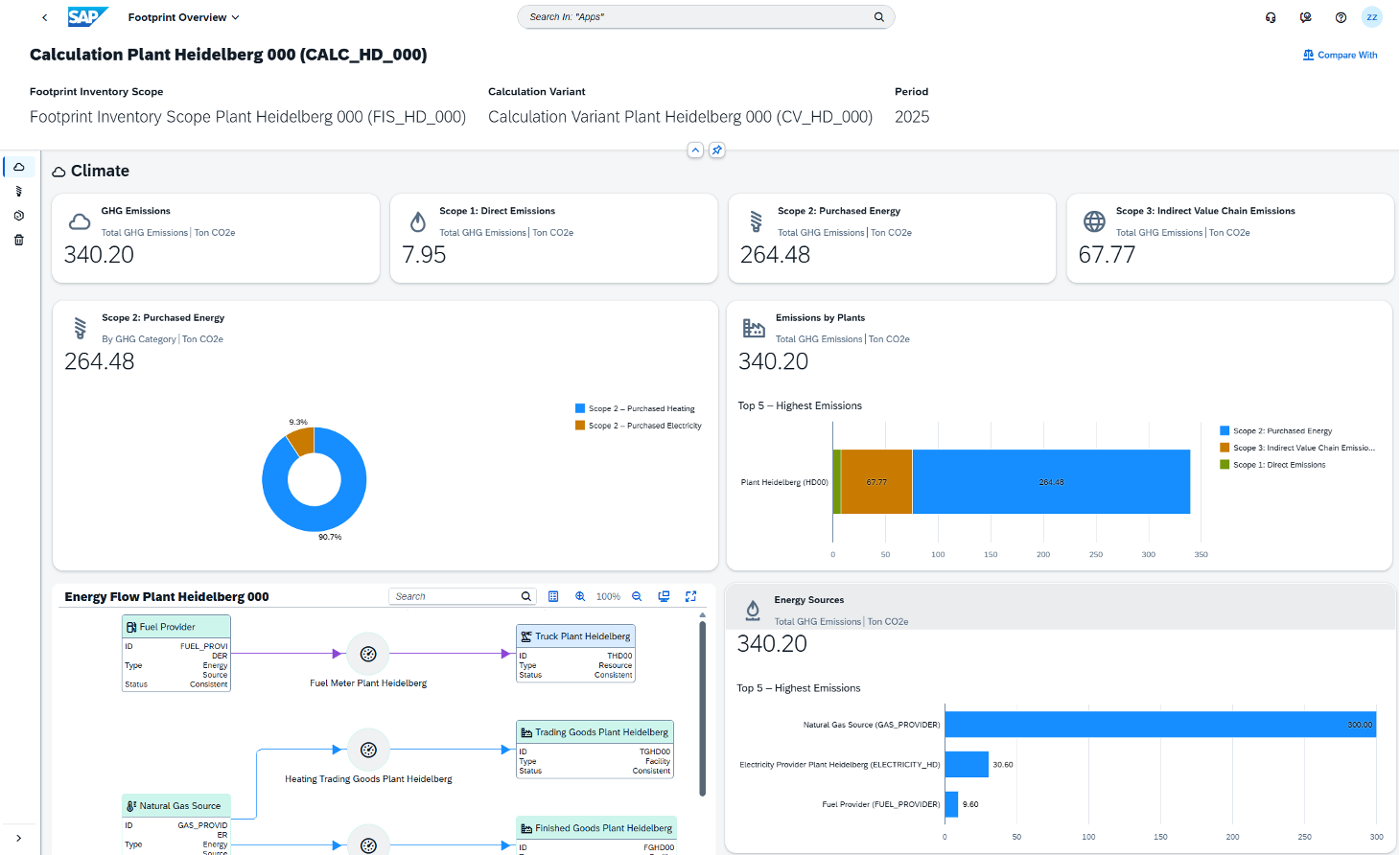
In this introductory exercise, students learn how energy flows are modeled in SAP SFM. Using Global Bike as an example, they see which energy sources and raw materials are required to operate a site, for instance for trucks or robots at the Heidelberg plant, and how these are recorded and counted. The energy flow is presented in a simplified way so that the relationships are easy to understand.
- Understand and build an energy flow model
- Record the energy sources and raw materials of a site
- Learn how consumption is counted and assigned to the model
Building on the energy flow model, students calculate the carbon footprint for the Heidelberg plant. They learn how to use business transactions and greenhouse gas data to arrive at a reliable result.
- Calculate the carbon footprint for the Heidelberg plant
- Define calculation variants and accounting boundaries
- Understand the results of the calculation
The case study explains all the steps required to calculate a carbon footprint in SAP SFM. It uses a realistic scenario at the German subsidiary of Global Bike. Global Bike Germany wants to analyze its corporate carbon footprint for the year 2025. The calculation for Heidelberg is already available from the exercises. Students extend the scope to the Hamburg distribution center and then consolidate both sites into one corporate footprint. Finally, they compare the results and derive a management recommendation.
- Create an energy flow model for the Hamburg DC
- Calculate the carbon footprint for the Hamburg DC
- Consolidate Heidelberg and Hamburg into one footprint for Global Bike Germany
- Display and analyze the corporate carbon balance
- Compare the results and derive a management recommendation
Prerequisite: successful completion of the exercises SFM Energy Flow and SFM Calculation.
SAP Sustainable Footprint Management Dashboard
Request Your Free Sandbox Now!
The SAP UCC offers free sandbox learning environments for an SFM system, including teaching materials. If you are interested and would like more information, click the button to get in touch with our customer service.
Please note: This offer is only available to academic instructors. Students, please contact your instructor.
Das sagen die Dozierenden

How Your Apprenticeship Continues
The SAP UCC Magdeburg offers you further practical curricula on current SAP solutions so that you can realise the full potential of your teaching and your students.